
The golf industry is going through a tough time, and we are
all hoping 2011 will be the turnaround, and golf will rebound. Golf in Michigan has been particularly hard hit due to the trials and tribulations of the regional corporations. Less people have joined clubs, companies are cutting back on outings, and golfers overall are simply playing less due to the financial and time constraints the economy has levied.
So, how is the Michigan Golf Industry to respond? It is time for a new paradigm. Business as usually will not suffice. Alterations to the existing game plan, such as cutting staff, or buying less will be enough to stem the tide. There needs to be a significant shift in how golf is offered to its customers, and how the golf product is devised, created and kept alive i.e designed, constructed and maintained.
The days of gigantic, wall-to wall green tracks, with equally oversized maintenance budgets are done, for the most part. There will always be the Augusta Nationals in every region. But, the core golf facilities – the ones that are needed to sustain the sport – will need to be sustainable themselves. And, to achieve this goal of sustainability, they will need to change their modus operandi. The only way this can be achieved is through a well conceived, thought out, comprehensive plan that will thoroughly analyze all aspects of the facility with respect to sustainability.
Every golf facility, from the sole proprietor daily fee to the equity membership private club, should have a Master Plan for Sustainability. This Master Plan for Sustainability should not simply be a map or a booklet that describes new bunkers, greens, tees and fairways. This Master Plan for Sustainability needs to review, analyze and describe in detail how the entire operation of the whole facility affects the energy, financial and human resources. Only through the efficient understanding and analysis of what a facility has, and how it operates, can a realistic and cost effective foundation for future sustainability be achieved.
This will be the first in a series of articles written about the Master Plan for Sustainability because this is not a subject that can be covered in a few paragraphs. And, in fact, the ideas and concepts that will be set forth cannot be generically applied to all facilities. The general sustainable principles that will be covered in future writing: energy reduction golf course design, renewable energy sources, water management, alternative fuels, recycling, composting and even how to incorporate other land uses into your facility that will improve the sustainability of not only the golf facility, but the community.
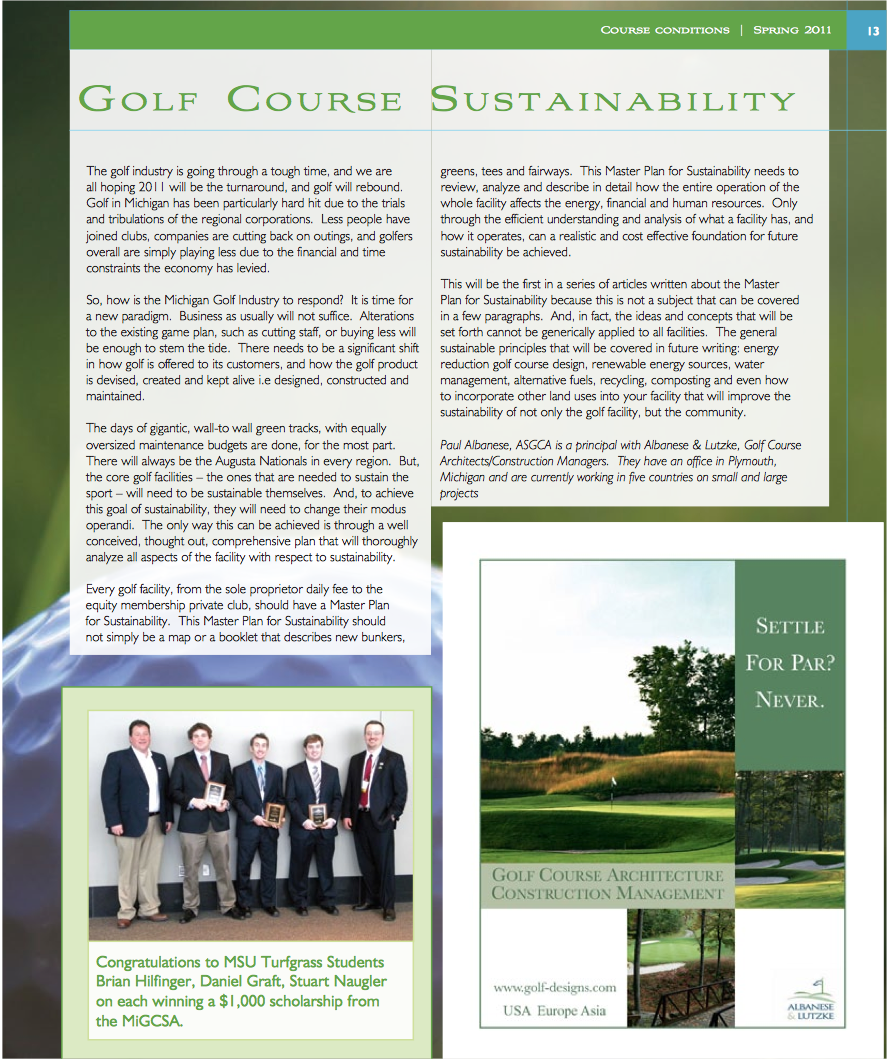
Paul Albanese, ASGCA is a principal with Albanese Golf Architecture & Construction Management. They have an office in Plymouth, Michigan and are currently working in five countries on small and large projects.